

Automotive AI conversations get judged on one question: does this sound like a person who knows what they’re talking about? Dealers ask it in every demo. Shoppers answer it in the first three seconds. And the honest truth is that a lot of AI in this industry still fails the test.
Not because the writing is bad. Because the AI isn’t listening.
The failure isn’t tone, it’s attention
Pull up a transcript from a generic chat product and the language usually reads fine. Polite, grammatical, on-brand. Then look at what the shopper said, and what came back.
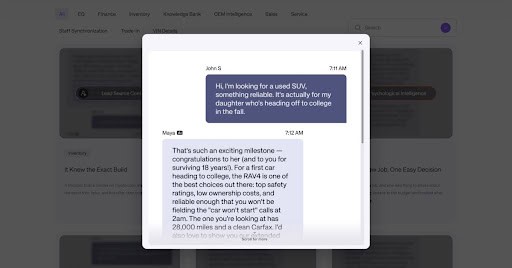
Someone mentions a budget concern, and the reply pushes the same vehicle at the same price. Someone says they already configured their trim on the OEM site, and the reply asks what they’re looking for. Someone says they’re buying for a daughter headed to college, and the reply lists horsepower.
That’s the gap. The words are right but the response is wrong, because nothing in the system registered what actually changed in the conversation.
In customer calls we reviewed across six months, buyers kept circling the same worries. Will this work with our CRM? Is the AI going to hallucinate? When does it need a human? Those aren’t questions about writing quality. They’re questions about judgment.
Four things an intelligent Automotive AI conversation does
So what separates a reply that moves a deal from one that stalls it? Four behaviors show up consistently.
It opens with what it already knows
A shopper who builds a Tundra 1794 Edition in Midnight Black on Toyota.com has already told you everything. Asking him to repeat it is the fastest way to lose him.
This is where most lead handling breaks first, and it’s not a writing problem. It’s a plumbing problem. The configuration data lands in one system, the lead lands in another, and whatever picks up the conversation starts from a blank slate. So the shopper gets asked what he’s looking for by a store that already has the answer.
A good opener names the exact trim, names the color, confirms what’s in stock, and mentions the live financing offer. Then it asks for a time. No re-explaining, no form-filling, no starting over.
The payoff isn’t just efficiency. Recognition builds trust in the first message, and trust is what earns you the appointment. A shopper who feels known will tell you more. A shopper who feels processed goes quiet and shops at the next dealership.
It catches the moment the intent shifts
Here’s one from a real exchange. A shopper says he loves the Tacoma TRD Off-Road, then adds that the monthly payment might be a stretch.
Nothing in the lead data flagged that. No form field captured it, no score predicted it. It surfaced mid-conversation, in a single sentence, and it changed the entire shape of the deal.
This is what separates following a conversation from running a cadence. A cadence would have sent the next scheduled message about the same truck at the same price. Instead the response named the TRD Sport at $38,400, offered certified pre-owned Tacomas with low miles, and made a case for running actual numbers together before he ruled the truck out.
He booked Saturday at 10.
Worth noticing what didn’t happen. The AI added options without abandoning the one he actually wanted. It made the case for running real numbers on the truck before he ruled it out. That’s the read a good salesperson makes, and it only works if the system is listening to what the shopper just said.
It adjusts to the person, not just the vehicle
A parent shopping for a first car for a college-bound daughter and a shopper weighing two luxury SUV trims are running completely different evaluations. The stakes are different, and so is the language that lands.
Good automotive AI conversations meet each on its own terms. For the parent: safety ratings, ownership costs, and an offer to bring the daughter along on the test drive. For the trim comparison: horsepower, zero-to-sixty, fuel economy, and both vehicles staged for a back-to-back drive. Same capability, two different reads.
Sometimes the read is about lowering pressure instead of adding detail. One shopper checked his credit score mid-conversation, decided he couldn’t qualify, and apologized for wasting the store’s time. The wrong response is a financing pitch. The right one tells him plenty of guests feel that way, offers to look at options together, and asks whether he’d rather come in or talk by phone. He picked the phone call.
That’s the skill underneath all three. Not a friendlier tone, but matching the response to what the person actually needs in that moment.
It knows when to stop
This one gets overlooked, and it might matter most.
After a series of follow-ups about ventilated seats, one shopper finally replied that he had no plans to come in and that Trevor, a friend of his who is a sales rep at the dealership, would be his contact when he is ready to buy. The right move there isn’t another cadence step. It’s “Thanks for telling me. I’ll stop contacting you given you’re in good hands with Trevor,” and steps back.
Restraint is a capability. Most automation is built to maximize touches, because touches are easy to count and persistence usually correlates with results. But the correlation breaks at the exact moment a customer tells you they’re done. Keep going past that line and you’re not nurturing a lead, you’re training someone to ignore your store.
An AI that can’t recognize a closed door will burn the relationship trying to open it. And the shopper who gets a graceful exit is far more likely to come back when the timing is right.
Why this matters more than the feature list
Every platform in this category claims humanlike conversation. You can’t test that claim in a demo, because demos are scripted and scripts don’t get surprised. A real conversation as it happened is harder to argue with.
Our new conversations resource page shows you the conversations happening through Impel. Read a few. If they sound like your best reps and service advisors on a good day, that’s the point.
Frequently Asked Questions
| Question | Answer |
| What makes automotive AI conversations different from general chatbot replies? | Automotive AI conversations use vehicle-level context that general chatbots don’t have. That means live inventory, VIN-specific details, trim and package differences, OEM incentives, and trade-in and financing information. A general model can write a fluent sentence. It can’t confirm that a specific Bronco Badlands in Eruption Green is in transit and arriving in seven to ten days. |
| How can a dealer tell if AI conversations are actually working? | Look at booked appointments and shows, not message volume. Then read the transcripts. Specifically, look for what happens when a shopper raises an objection, changes direction mid-thread, or asks something outside the script. Those moments reveal whether the system is following the conversation or running a cadence. |
| Will AI conversations replace a dealership’s sales team? | No. Impel’s AI handles the repetitive volume, the after-hours messages, and the follow-up that would otherwise go undone, so the team spends its time with customers who are ready to buy. Several conversations on our resource page show the AI and a rep working the same thread together, and others show the AI stepping back once a customer names the person they want to work with. |
| What happens when the AI doesn’t know the answer? | It routes to a person. The AI Knowledge Bank covers dealership policies, FAQs, and offerings, so store-specific questions get store-specific answers. Anything outside that scope, or any moment that calls for a human, gets escalated with the full conversation history attached. |